
Last updated November 2, 2026
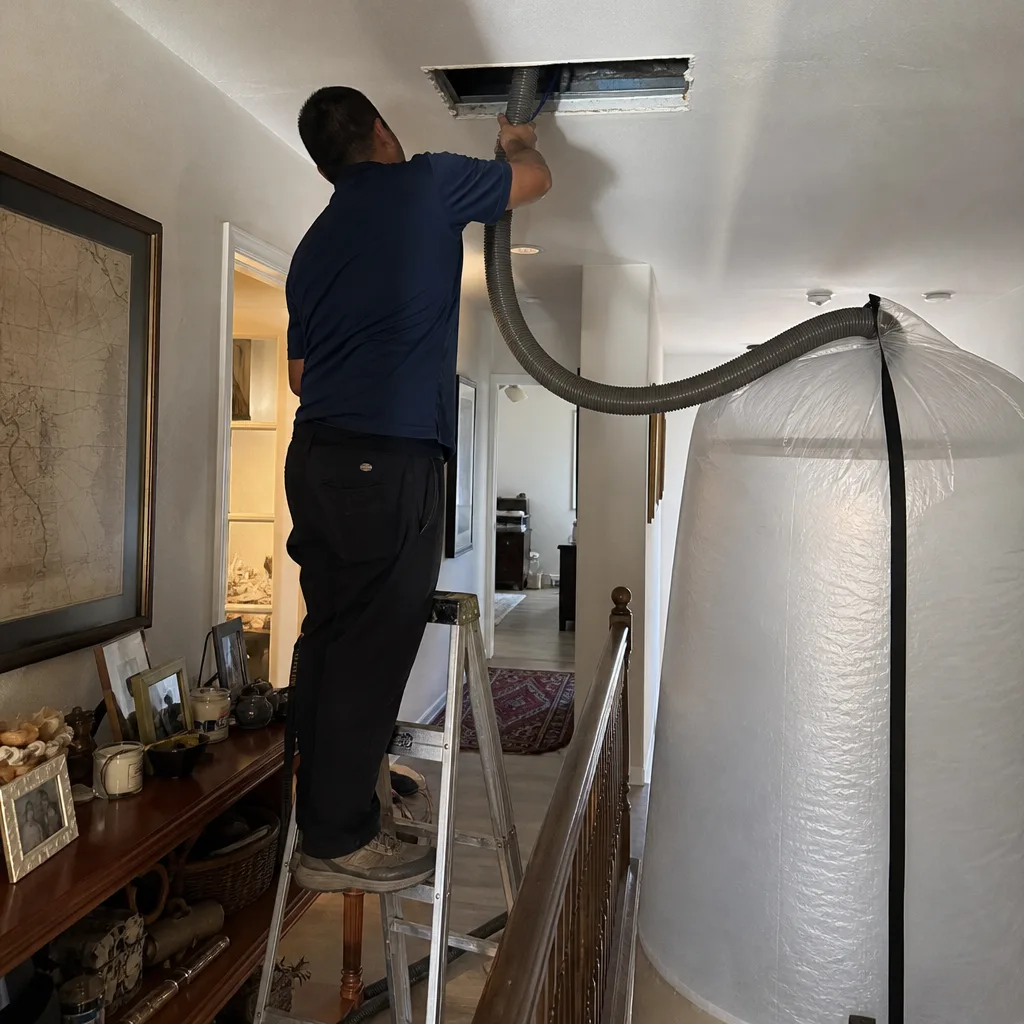
 Whole-home duct cleaning
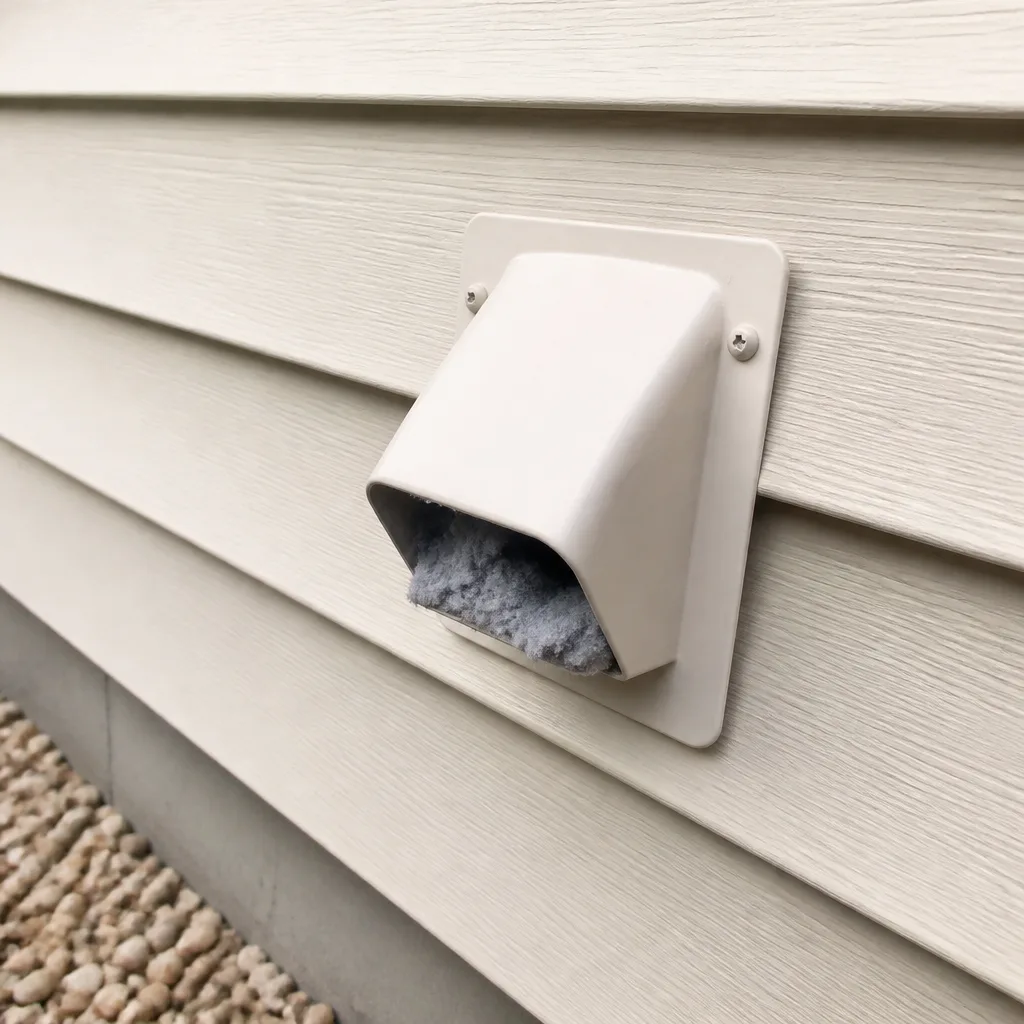 Dryer vent cleaning
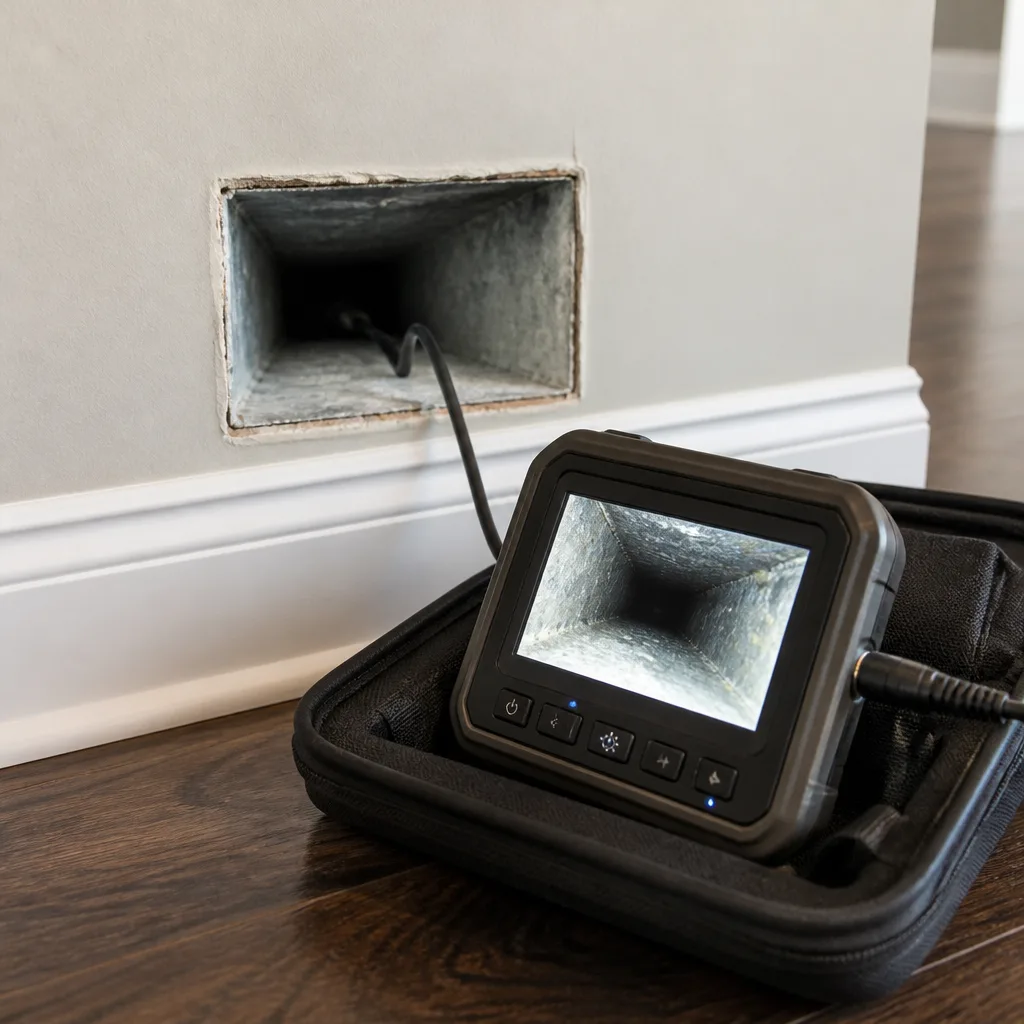 Camera inspection
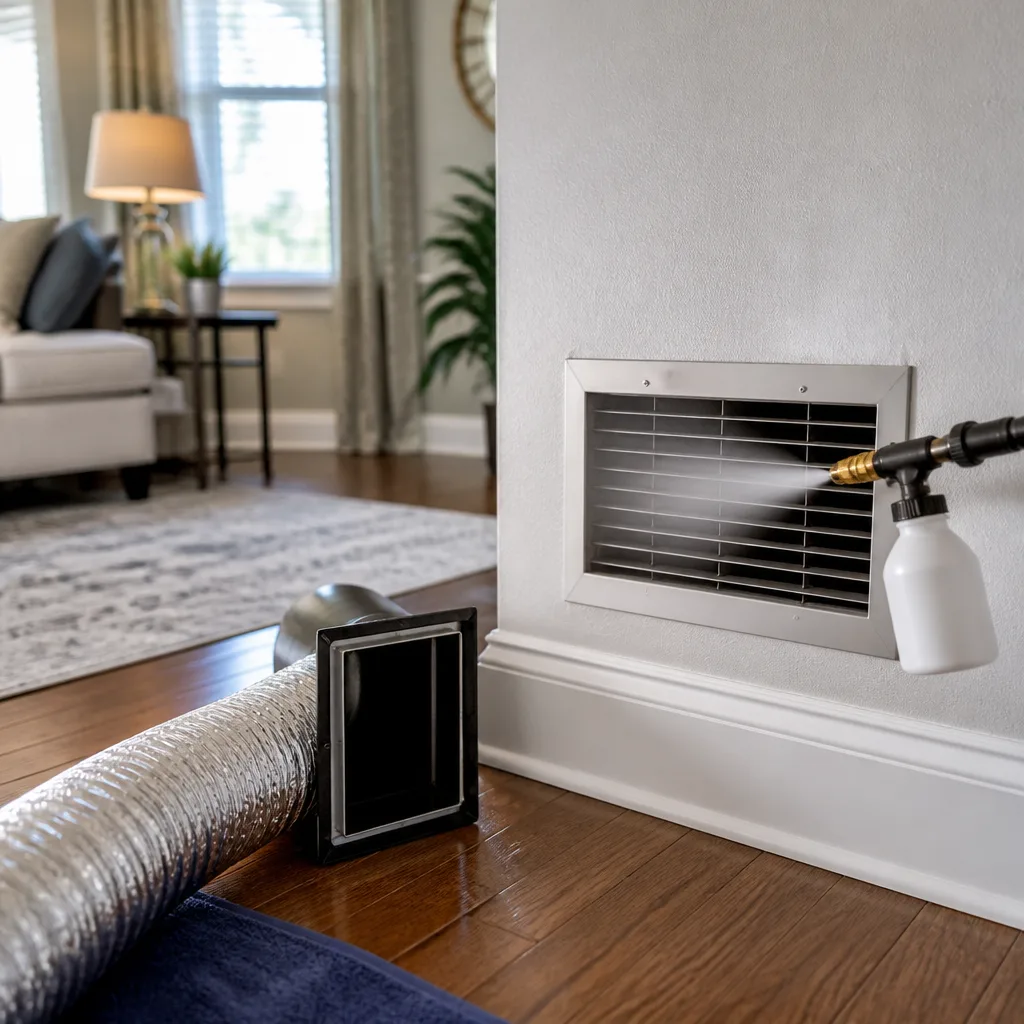 Sanitizing & deodorizing
Whole-system duct and dryer vent check with before-and-after photos - you see exactly what came out of your vents
That "$99 whole-house special" is a bait ad - the real number appears once they are in your hallway, or the "clean" is a shop-vac at the register. We photograph the inside of your ducts before and after instead.
The Complete Air Duct Cleaning Guide for Encinitas Homeowners
Most air duct cleaning guides read like they were written for a house in Ohio. Basement furnaces. Long duct runs through freezing crawl spaces. Snow melt and salt. Encinitas has none of that – and the assumptions baked into generic advice collapse the moment you look at how a coastal San Diego home actually moves air. What we get instead is marine-layer humidity pressing against single-story slab construction, flex ducts sweating in attics, and fine wildfire particulates that behave nothing like the chunky debris those Midwest guides talk about. This guide maps the actual cleaning process – the equipment, the access points, the inspection steps – to what’s really inside the walls and ceilings of an Encinitas home.
Styles & brands we work with
- Whole-home duct cleaning
- Dryer vent cleaning
- Camera inspection
- Sanitizing & deodorizing
Quick Answer
Air duct cleaning in Encinitas typically costs $325 – $650 for a whole-home system, depending on square footage and the number of air handlers, and it removes accumulated dust, pet dander, allergens, and wildfire particulates from your entire duct network. The process uses professional-grade negative-pressure equipment that pulls debris out rather than pushing it around, and it should include a pre- and post-cleaning borescope inspection so you can verify the work. For homes in Encinitas’s coastal zone, where marine-layer humidity raises microbial risk inside flex duct, a thorough cleaning every 3 – 5 years is a realistic maintenance interval, not an upsell.
Table of Contents
- Why Encinitas Homes Are Different: Coastal Humidity, Slab Construction, and Wildfire Particulates
- How Air Duct Cleaning Actually Works: Equipment and Process
- Access-Point Mapping: Which Registers, Plenums, and Air Handlers Get Cleaned
- Source Removal vs. Blow-and-Collect: Why the Method Matters in Encinitas
- Mold, the Marine Layer, and 1980s – 2000s Flex-Duct Construction
- Reading Your Pre- and Post-Cleaning Inspection Report
- The NADCA ACR Standard in Plain Terms
- How Often Does a Coastal San Diego Home Really Need Duct Cleaning?
- The Two Services Most Cleaning-Only Companies Skip: Repair and Dryer Vents
- Common Mistakes to Avoid
- When to Call a Professional
- Frequently Asked Questions
- The Bottom Line
Why Encinitas Homes Are Different: Coastal Humidity, Slab Construction, and Wildfire Particulates
An Encinitas home moves air differently than almost anywhere else in the country. The first thing to understand is that most homes here sit on a concrete slab. There is no basement service closet, no cellar duct matrix. Your air handler is either in the garage, in an attic knee-wall space, or tucked into a hall closet. Duct runs are shorter than in a Northern climate, but they’re often routed through unconditioned attics that bake in the afternoon sun and cool overnight into the marine layer’s condensation zone.
That temperature swing is where the trouble starts. Encinitas’s coastal humidity – average morning relative humidity runs 70 – 80 percent for much of the year – means the air inside your attic ductwork is frequently near its dew point. Any small gap in duct insulation, any joint that’s loosened over two decades of thermal expansion, becomes a point where condensation forms on the inside of the duct jacket. Condensation acts as a glue. It catches particulate matter that would otherwise blow through the system and deposit on a register face. It also creates exactly the surface moisture that dust mites and mold spores need to colonize inside a flex-duct liner.
Then you add the wildfire factor. Fall in Encinitas brings Santa Ana winds, and with them, fine particulates from fires burning inland. These particles – under 2.5 microns in many cases – are chemically different from ordinary household dust. They’re smaller, lighter, and more likely to remain suspended in the airstream. They settle in the duct lining, the blower fan blades, the evaporator coil, and the return-air plenum. When you understand that combination – condensation-driven adhesion plus fine-particulate loading – you understand why Encinitas ducts get dirty in a way that a dry-climate home’s ducts never do.
How Air Duct Cleaning Actually Works: Equipment and Process
There are two fundamentally different approaches to cleaning ductwork, and the equipment used determines which one you’re actually getting. The first – common with low-bid operators – is a “blow-and-collect” or vacuum-only method. The technician cuts a single access hole, inserts a vacuum hose, and uses compressed air or a handheld brush to push debris toward the vacuum. In an Encinitas flex-duct system, this method leaves a significant amount of material behind because flex duct has a spiral wire core and a ribbed inner liner that traps fine particulates mechanically.
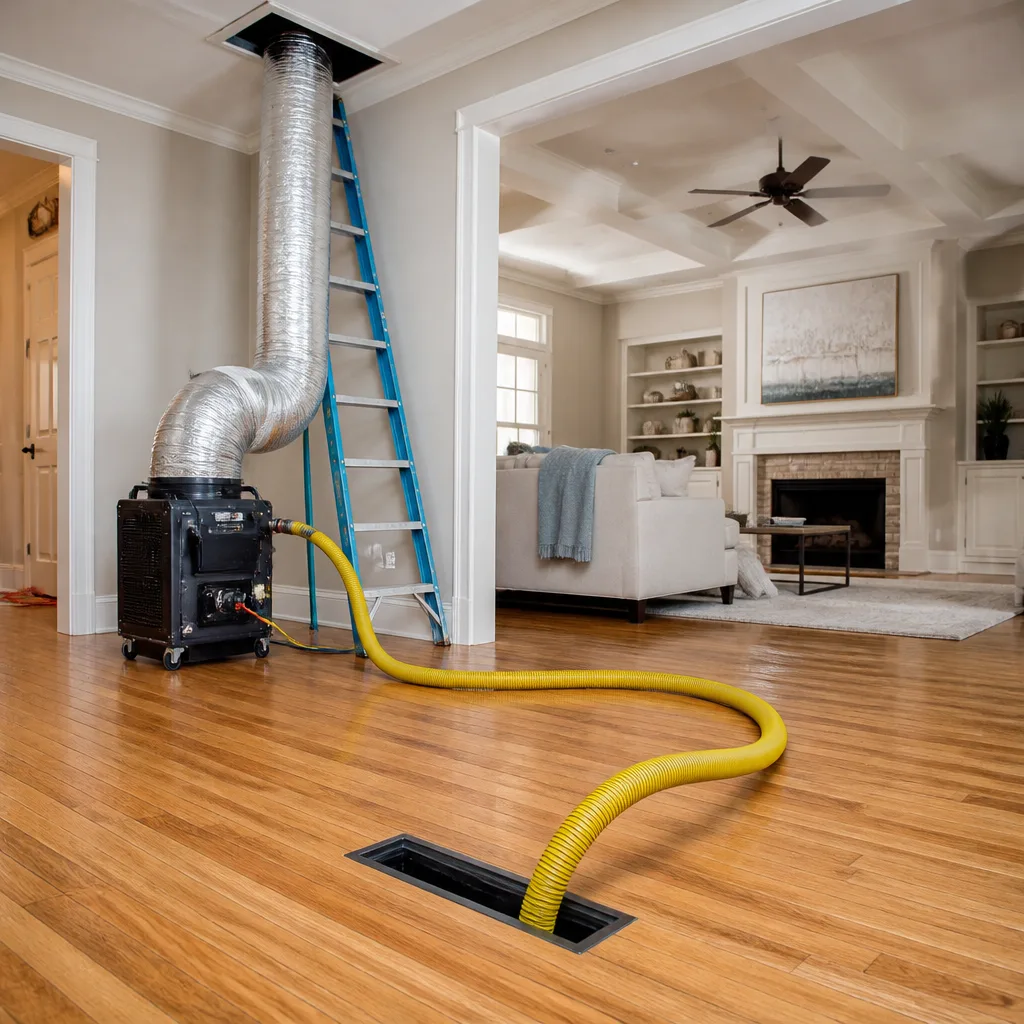
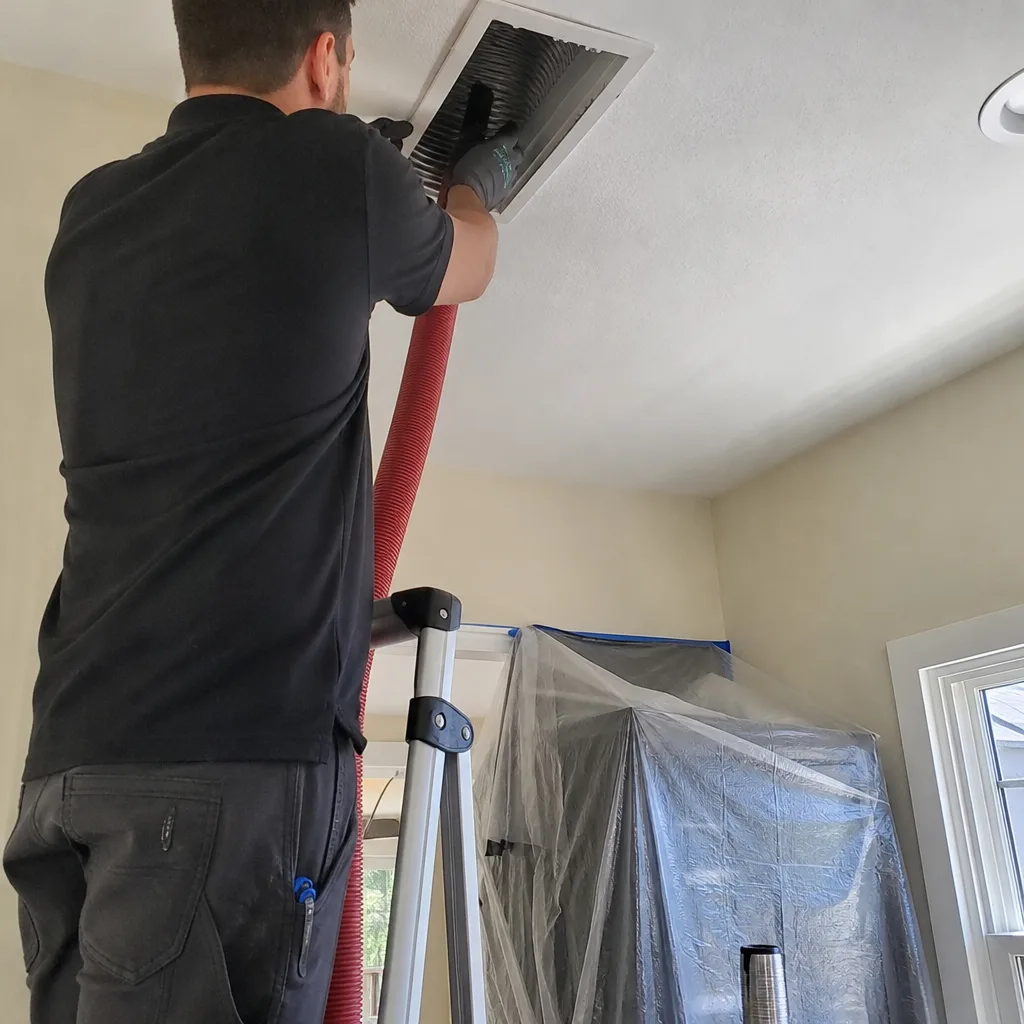
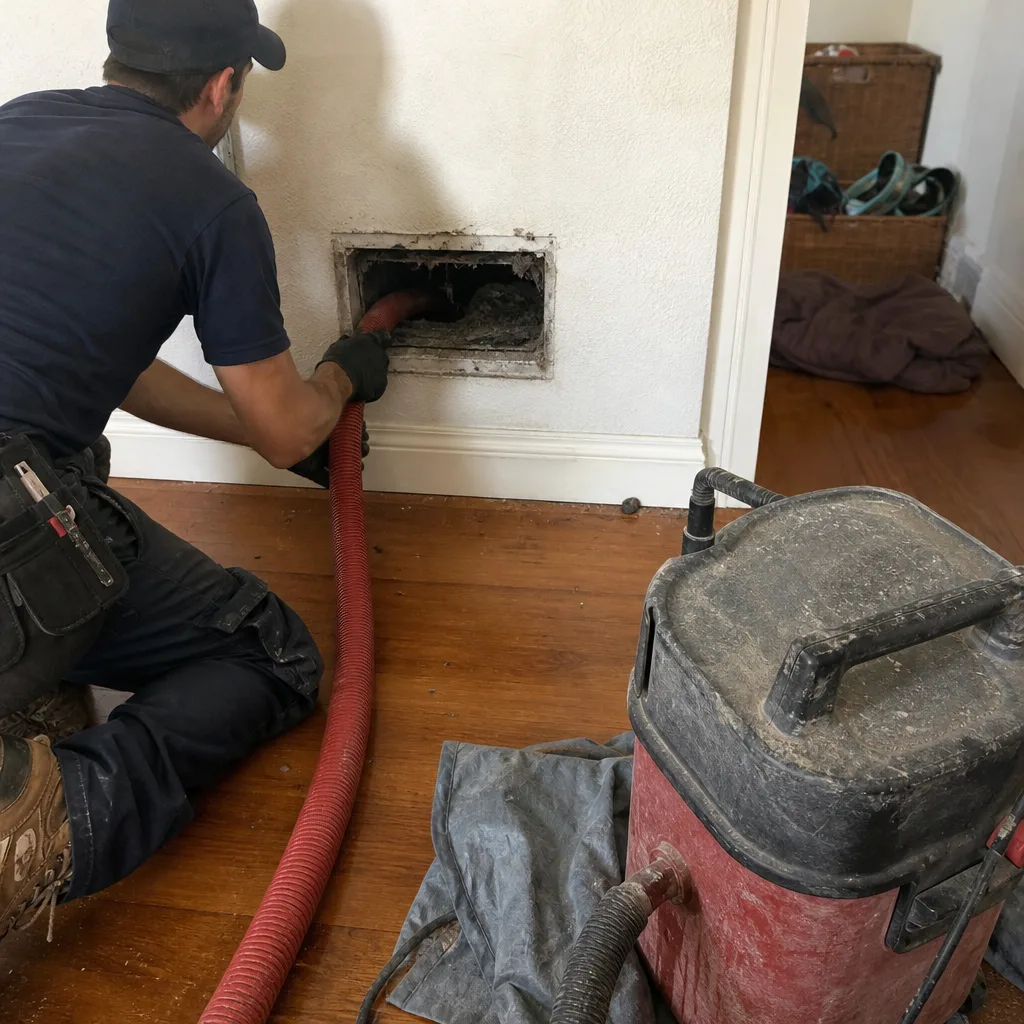
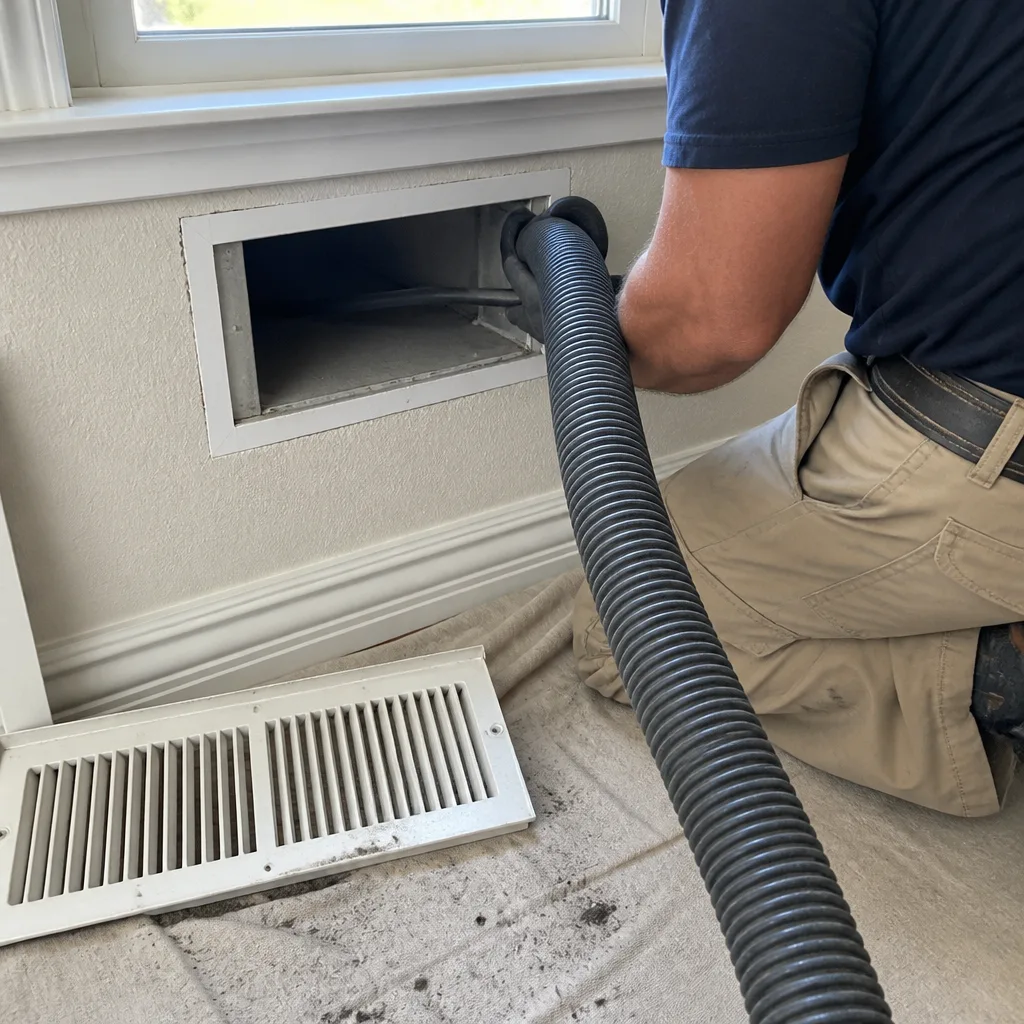
The second method is negative-pressure source removal. A high-capacity vacuum unit – typically a truck-mounted or high-output portable system like a Rotobrush or Nikro configuration – is connected to the duct system to create continuous negative pressure. While the system is under vacuum, a rotary brush or pneumatic agitation tool is inserted through each access point to dislodge debris from the interior walls. Because the entire duct run is under negative pressure, dislodged particles are pulled toward the vacuum collection point rather than escaping into the living space. Abatement Technologies filtration units are often added at the return-air side to capture any particulates that become airborne during the cleaning process.
The key distinction: source removal extracts material; blow-and-collect redistributes it. In an Encinitas home with fine wildfire residue coating the duct liner, the difference in outcome is measurable – and it’s visible on a post-cleaning borescope inspection.
Here’s the standard process sequence at Air Duct Cleaning in Encinitas, step by step:
- System inspection. The technician evaluates the air handler, return plenum, supply trunk lines, and accessible branch runs. A borescope camera is inserted through existing access points and new ones are cut only where the duct layout requires them.
- Access-point creation. Small access ports – typically 6 to 8 inches – are cut at strategic locations: the return plenum, the supply trunk after the air handler, and any branch-line junctions where turns trap debris.
- Negative-pressure connection. The vacuum unit is connected to the main trunk line, with the system sealed to maintain suction throughout cleaning.
- Mechanical agitation. A rotary brush or pneumatic agitation tool is run through each supply run and the return drop, breaking the mechanical and static bond that holds debris to the duct walls.
- Component cleaning. The blower fan, evaporator coil face, and air handler cabinet are cleaned separately – these are the components most companies skip entirely.
- Access-port sealing. All access holes are sealed with gasketed metal caps and mastic or foil tape, restoring the duct’s airtight envelope.
- Post-cleaning verification. A final borescope inspection documents the result. You should receive images showing the interior walls of your ducts, before and after, side by side.
Access-Point Mapping: Which Registers, Plenums, and Air Handlers Get Cleaned
The single most common complaint we hear from Encinitas homeowners after a cleaning from a discount operator is that the registers were wiped down but the inside of the system was never touched. That’s not a failed cleaning; it’s a superficial one. Here’s what a complete job actually covers:
- Supply registers and grilles in every room. These are removed, washed, and re-installed. Visible, but the least important part of the job.
- Supply branch runs from the trunk line to each register. These flex-duct sections are where pet dander and fine particulate settle. Each run gets individually brushed.
- Return-air grilles and return drops. The return pulls air from the home back to the air handler. This is usually the dirtiest section in an Encinitas home because the return draws from the living space where people, pets, and cooking generate constant particulate.
- The return plenum and supply plenum – the box sections where the main trunk connects to the air handler. These are collection points for everything the filter didn’t catch.
- The air handler cabinet, blower fan, and evaporator coil face. If your blower wheel is caked with dust and the coil face is matted, you have a system-level airflow restriction that no duct-only cleaning will fix.
- The main trunk line. The central artery of the duct system. In a slab home, this run may pass through the attic or drop through a chase. It’s the largest volume of metal or flex, and it needs the full negative-pressure treatment.
A company that skips any of these – especially the air handler and coil – is doing half a job. Ask explicitly before you book: “Does the price include the blower fan and evaporator coil?” If the answer is vague, you’re likely looking at a register wipe and a vacuum pass.
Source Removal vs. Blow-and-Collect: Why the Method Matters in Encinitas
The fine-particulate profile of an Encinitas home – dominated by wildfire residue, pollen from coastal sage and eucalyptus windbreaks, and the microscopic dust generated by constant window-open living – does not respond well to blow-and-collect methods. These particles are too small and too adhesive. A burst of compressed air dislodges the top layer and sends it swirling into the duct interior, where it resettles the moment the air current drops.
Negative-pressure source removal solves this mechanically. When the entire duct run is under continuous vacuum, dislodged material cannot resettle – it is pulled out of the system in real time. The agitation tool breaks the bond; the vacuum removes the material. This is why commercial remediation contractors have used negative-pressure equipment for decades. It’s also why Duct Cleaning Encinitas home equipment standards are built on professional-grade systems: Rotobrush and Nikro rotary-brush platforms paired with Abatement Technologies air-filtration units.
What matters to a homeowner is simpler than the equipment roster: you should know, before you book, whether the company uses true negative-pressure extraction or a vacuum-only method. Ask directly. A company that can’t answer the question, or that answers with “we have the best equipment,” is telling you something. The method determines whether the fine material in your ducts leaves your house or just moves around inside it.
Mold, the Marine Layer, and 1980s – 2000s Flex-Duct Construction
Encinitas grew fast between the early 1980s and the mid-2000s, and that building boom was dominated by single-story tract homes on slab foundations. Those homes, by and large, are served by flex duct: flexible, insulated duct sections with a thin inner liner over a spiral wire core. Flex duct is not inherently problematic, but it has specific vulnerabilities in a coastal climate.
The inner liner is typically a thin poly or foil layer. Over 20 to 30 years, it degrades. Tiny pinholes form. The outer insulation – usually fiberglass – stays intact, but the liner’s integrity is what keeps moisture and microbial growth off the insulation fibers. When a liner develops gaps, two things happen: condensation from Encinitas’s marine-layer humidity wicks into the fiberglass, and the fiberglass itself becomes a particulate source feeding into your air stream.
The microbial risk is real. We don’t use scare language in this line of work because the science doesn’t require it: mold needs surface moisture, organic food material, and time. Encinitas supplies all three. A flex-duct run in an attic that swings between 50 degrees at night and 90 degrees in afternoon sun creates condensation cycles inside the duct. When that condensation meets accumulated organic dust – skin cells, pet dander, pollen – the conditions for microbial growth exist. Not exaggeration; basic building science.
What that means practically: if your Encinitas home was built between 1985 and 2005 and you’ve never inspected the duct liner, you should have it looked at. A borescope inspection through the access ports will show liner condition, evidence of condensation staining, and any areas where the flex has collapsed or sagged and is trapping material. If the liner is compromised, cleaning alone will not solve the problem – that’s where Air Duct Repair in Encinitas comes in. A section of failed flex can be replaced, sealed, and brought back to spec. The trick is that you can’t repair what you haven’t inspected, and most cleaning-only companies don’t inspect.
Reading Your Pre- and Post-Cleaning Inspection Report
A legitimate duct cleaning in Encinitas produces documentation. You should receive a pre-cleaning inspection record, a post-cleaning verification record, and – ideally – borescope images from both stages. If a company charges you hundreds of dollars and hands you nothing but a receipt, you weren’t given the means to verify the work.
Here’s what to look for in the pre-cleaning report:
- Duct-liner condition – specifically, whether the inner liner shows tears, pinholes, condensation staining, or signs of microbial growth. An Encinitas home older than 20 years with original flex duct is a candidate for liner compromise.
- Debris type and location – the report should note what kind of material was found and where. Fine gray powder near the return drop indicates wildfire-season particulate loading. Fibrous material may indicate liner breakdown. Clumps of pet hair at branch-line junctions point to low airflow velocity in those runs.
- Evaporator coil condition – matted coil faces restrict airflow and reduce system efficiency. The pre-clean report should document whether the coil requires cleaning, and the post-clean report should show it after.
- Access-point locations – every access port cut for the cleaning should be documented with its location and a note on how it was resealed.
The post-cleaning report should include borescope images showing the same duct sections from the pre-cleaning report. Compare them side by side. The interior liner should be visible in the post-clean images – you should see the liner pattern or the metal surface, not a film of dust. If the post-clean images look like the pre-clean images with a different time stamp, that’s a conversation.
A professional borescope inspection in an Encinitas home should also document what wasn’t accessible. Honest reporting means telling you when a branch run is fully embedded in a slab chase and cannot be accessed without destructive work. That’s real-world ductwork in this city – some runs are simply not reachable – and a contractor who tells you that is worth more than one who claims 100 percent access and can’t show you the photos to prove it.
The NADCA ACR Standard in Plain Terms
NADCA – the National Air Duct Cleaners Association – publishes the industry standard called the ACR, or Assessment, Cleaning, and Restoration of HVAC Systems. It’s the closest thing the industry has to a rulebook, and it’s the standard reputable contractors point to when asked how they determine what’s clean.
The ACR standard says, in effect, that HVAC cleaning should be performed using source-removal methods, that all system components – not just the duct walls – should be part of the cleaning scope, and that cleaning should be verified with inspection. Critically, the standard also gives a simple definition of “clean”: the interior surfaces of the HVAC system should be visibly free of non-adhered debris. Not sterile. Not disinfected. Clean means you can look at the liner with a borescope and see the material it’s made of, not a layer of accumulated dust.
What NADCA doesn’t do is license or certify individual companies as a regulatory body. Any company can claim to “follow NADCA standards.” The way to verify compliance in Encinitas is to ask the company to show you their process against the standard: Do they clean the coil and blower? Do they use negative pressure? Do they provide photographic verification? A company that says “NADCA” and then hands you a scope-of-work that excludes the air handler is not following the standard they’re citing.
You can verify NADCA membership on the association’s public directory. It’s a five-minute check that filters out most of the discount operators. And it matters more in Encinitas than in most markets because our coastal conditions make duct contamination a chronic issue, not a one-time event.
How Often Does a Coastal San Diego Home Really Need Duct Cleaning?
The honest answer for Encinitas: every 3 to 5 years, with adjustments based on what’s living in your house and what the weather did last fall. That’s a tighter interval than the 5-to-7-year figure you’ll see in national guides, and it’s tuned to our specific conditions.
Here’s the reasoning. A single-story slab home in Encinitas with a 3-ton system has maybe 250 to 350 linear feet of ductwork, much of it running through an unconditioned attic. That’s a substantial interior surface area, and it’s all exposed to the condensation cycles we described earlier. Add two dogs, a cat, and a family of four – plus a September where the Santa Anas pushed wildfire smoke over the coast for a week straight – and you’ve loaded the system with material in a way a Phoenix home never will.
Some households should clean more often. If anyone in the home has asthma or significant allergies, every 2 to 3 years is defensible – not because the ducts are the primary source of allergens, but because they recirculate and redistribute whatever is in the living space. The same applies to homes with multiple pets or homes where a renovation was completed without sealing off the returns. Drywall dust is fine enough to hang in the airstream for weeks and sticky enough to coat a duct liner permanently once it settles in a coastal humidity environment.
The flip side: a single adult in a newer Encinitas home with high-efficiency filtration may genuinely not need duct cleaning for 5 to 7 years. The point of the inspection-first approach is that you don’t have to guess. A borescope look at your return plenum and coil face tells you in ten minutes whether there’s work to do.
The Two Services Most Cleaning-Only Companies Skip: Repair and Dryer Vents
Here’s a structural issue in our industry: the majority of companies that offer duct cleaning in San Diego County are cleaning-only operations. They can remove debris, but they can’t repair a compromised duct. In Encinitas, where flex-duct liners degrade under decades of condensation cycling, that’s a critical limitation.
The scenario plays out constantly. A technician cleans the system thoroughly, then discovers during the post-cleaning inspection that a section of flex in the attic has a compromised liner – the fiberglass insulation is exposed and shedding, and the condensation point means the cleaned duct will re-contaminate quickly. A cleaning-only company has two options: tell you it’s fine (it isn’t) or refer you to another contractor, which adds cost, delay, and a second appointment. A company that offers both air duct cleaning and air duct repair fixes the compromised section in the same service window, sealed and verified against the same inspection standard.
The same pattern applies to dryer vents. Dryer Vent Cleaning in Encinitas is one of the most concrete safety services in the home-services trades – the U.S. Fire Administration identifies dryer-vent fires as a leading cause of residential structure fires, with lint accumulation as the primary ignition fuel. A dedicated dryer-vent cleaning removes the lint load through the full vent run, from the dryer connection to the exterior termination. Most duct cleaners treat dryer vents as an add-on if they offer it at all. In an Encinitas laundry room, where the dryer vent often runs through an exterior wall or up through a chase to a roof termination, that lint is building up somewhere too narrow to see. The service is simple, the fire-risk reduction is real, and it belongs on the maintenance calendar at least every two years – more often if you run multiple loads a day.
After cleaning, some Encinitas homeowners ask about long-term air-quality systems. That’s where equipment partners like Honeywell and Aprilaire come in – whole-home filtration and humidity-control products that address the post-cleaning environment. The economics are straightforward: cleaning removes what’s already in the ducts; filtration reduces what enters them next. A Honeywell media filter with a high MERV rating does more to keep a coastal home’s ducts clean between service visits than any cleaning does on its own. And if wildfire season becomes a regular feature of Encinitas autumns, Aprilaire whole-home purifiers designed for fine-particulate removal are a serious consideration.
Common Mistakes to Avoid
- Booking based on the lowest bid. In the duct-cleaning trade, the price difference between a legitimate source-removal job and a blow-and-collect job is $200 – $400. The cheaper service isn’t a better deal; it’s a different service. In an Encinitas flex-duct system, the cheap service leaves the fine material that matters most behind.
- Skipping the air handler and coil. If the blower fan is caked and the coil face is matted, cleaning only the branch runs solves a third of the problem. Ask whether the coil and blower are in the scope before you book.
- Accepting a cleaning with no photographic proof. A company that can’t show you before-and-after borescope images is a company that didn’t necessarily do what it said. Documentation is standard practice for professional operators.
- Ignoring a compromised liner. Cleaning flex duct with a degraded liner is the equivalent of washing a moldy sponge. The liner problem has to be fixed or the cleaning won’t hold. Any Encinitas home with original ductwork from the 1980s – 2000s should be inspected for this specifically.
- Waiting for an odor to take action. By the time you can smell what’s in your ducts, the material load is significant. Odor means microbial activity or severe particulate accumulation, both of which are more expensive to remediate than to clean.
- Treating dryer-vent cleaning as optional. Lint in a dryer vent is combustible material in a confined run. It’s a fire-safety item, not a comfort item, and the cost of a cleaning is trivial next to the alternative.
- Assuming every access point is reachable without inspection. Slab construction in Encinitas means some branch runs are enclosed in chases. A reputable contractor documents what’s accessible and what isn’t – and tells you before the work starts, not after.
When to Call a Professional
Some situations can wait, and some shouldn’t. If you can see dust puffing from your registers when the system starts, that’s a signal the duct interior is loaded and you’re blowing accumulated material into your living space. If you’ve lived in your Encinitas home for more than four years and can’t remember the last duct inspection, that’s a signal too. If you renovated recently and didn’t seal the returns, drywall dust is now distributed through the system. If someone in the household has allergies that worsen when the HVAC runs, the recirculating load is part of the problem. And if your home was built between 1980 and 2005 with original flex duct, the liner has aged – condensation cycling in the marine layer has been working on it for decades. These aren’t emergencies, but they are reasons to get a qualified inspection sooner rather than later. Duct Cleaning Encinitas offers free estimates in Encinitas – call (866) 596-9358.
Frequently Asked Questions
Whole-home air duct cleaning in Encinitas typically runs $325 – $650, depending on square footage, the number of air handlers, and the condition of the system. That price should include the blower fan and evaporator coil – if it doesn’t, the quote is for a partial job. Call (866) 596-9358 for an exact estimate for your home; estimates are free.
Cheaper quotes usually come from vacuum-only operators who skip negative-pressure source removal, the air handler, or both. The $99 whole-house special is a register wipe and a vacuum pass. Real source removal in an Encinitas home, with borescope verification and component cleaning, costs more because it takes more equipment and time. The method difference is visible in before-and-after photos.
Demand pre- and post-cleaning borescope images of the same duct sections, side by side. A professional operator in Encinitas provides this as standard practice. If a company can’t or won’t show you the interior of your own ducts after cleaning, you have no way of verifying the result.
Every 3 to 5 years for most households, with a 2-to-3-year interval for allergy sufferers, pet-heavy homes, or homes that experienced wildfire-season particulate loading. The marine layer’s condensation cycles mean material adheres more aggressively here than in drier climates. Inspection is the deciding factor – not a generic timeline.
Yes, but with a nuance: ducts are a recirculation system, not a source. Cleaning removes accumulated allergens from the system so they stop redistributing through your living space, but if the home itself is dusty, the ducts will reload. Whole-home filtration from brands like Honeywell or Aprilaire addresses the ongoing particulate input. Cleaning and filtration together produce the most durable result.
Microbial growth inside flex duct is more common in Encinitas than in drier inland communities because condensation cycles are more frequent and sustained. The risk is highest in homes built between the 1980s and 2000s where original flex-duct liners have had decades to degrade. A borescope inspection shows liner condition and any condensation staining that indicates active risk.
The Bottom Line
Air duct cleaning in Encinitas is not a generic home-maintenance box to check. Our homes move air through slab-on-grade layouts with flex duct in coastal attics, and the particulars of that arrangement dictate everything about how cleaning should be done. Source-removal negative pressure beats blow-and-collect every time, and the verification is what separates a professional job from smoke and mirrors. Inspect the liner. Clean the coil and blower. Repair what’s compromised. Clean the dryer vent as a safety measure, not an add-on. And consider filtration as the durable fix between cleanings. If you’d like an honest assessment of your system, Duct Cleaning Encinitas offers free estimates in Encinitas – call (866) 596-9358.
Written by the team at Duct Cleaning Encinitas, serving Encinitas since 2017.
See the difference
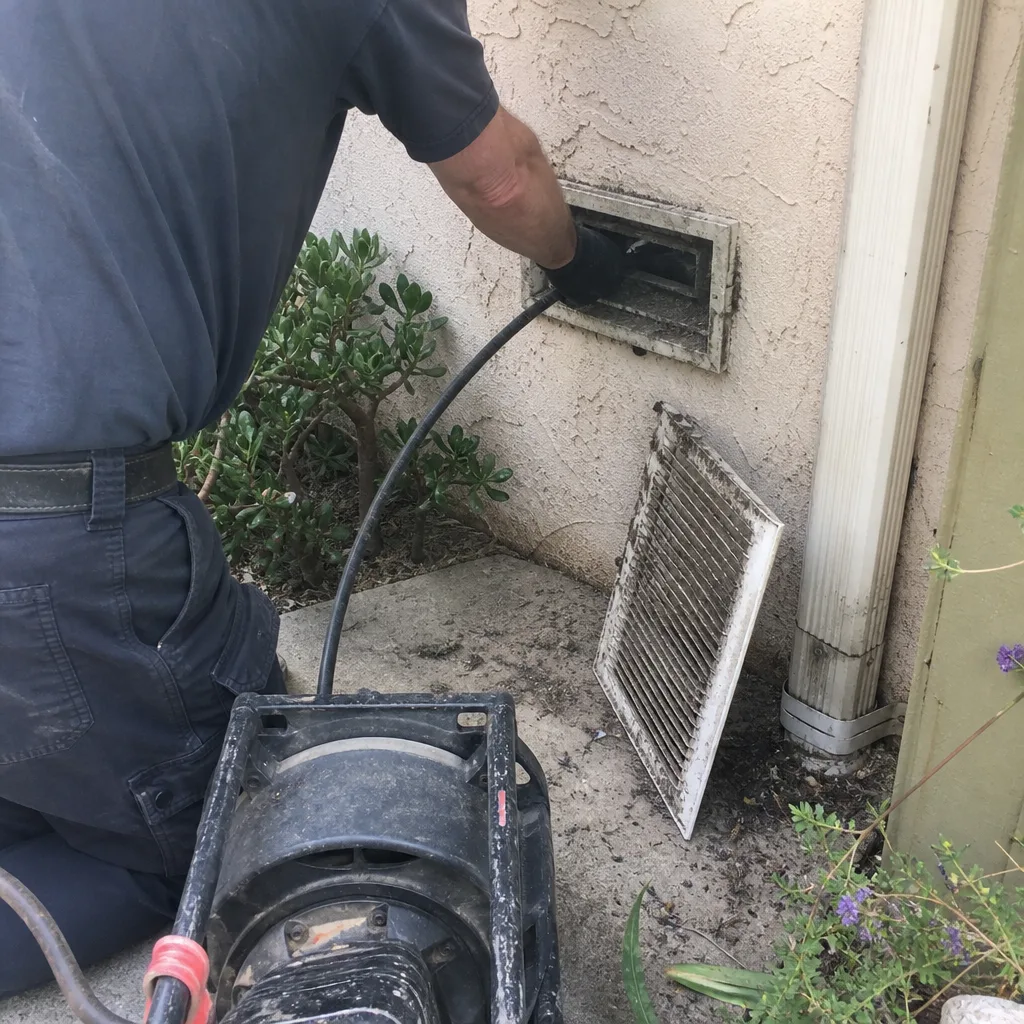 Before
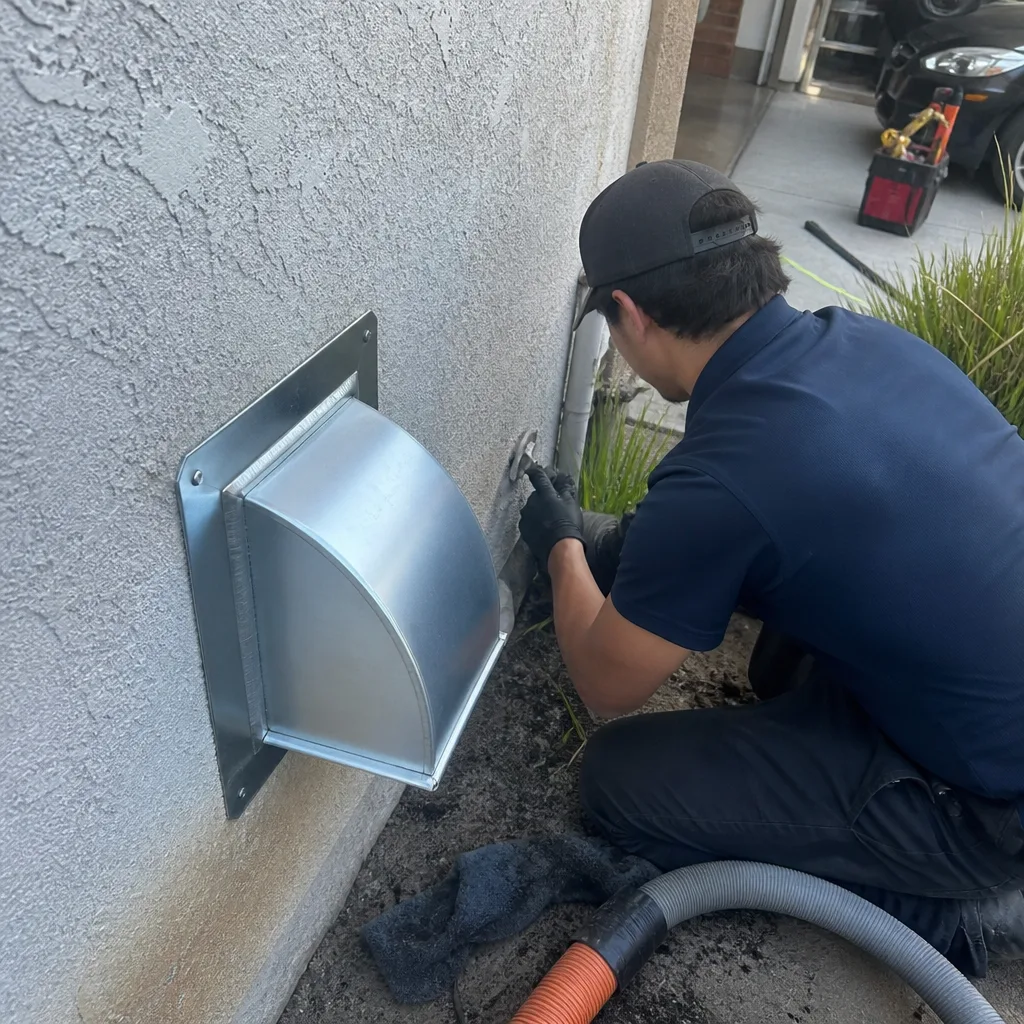 After
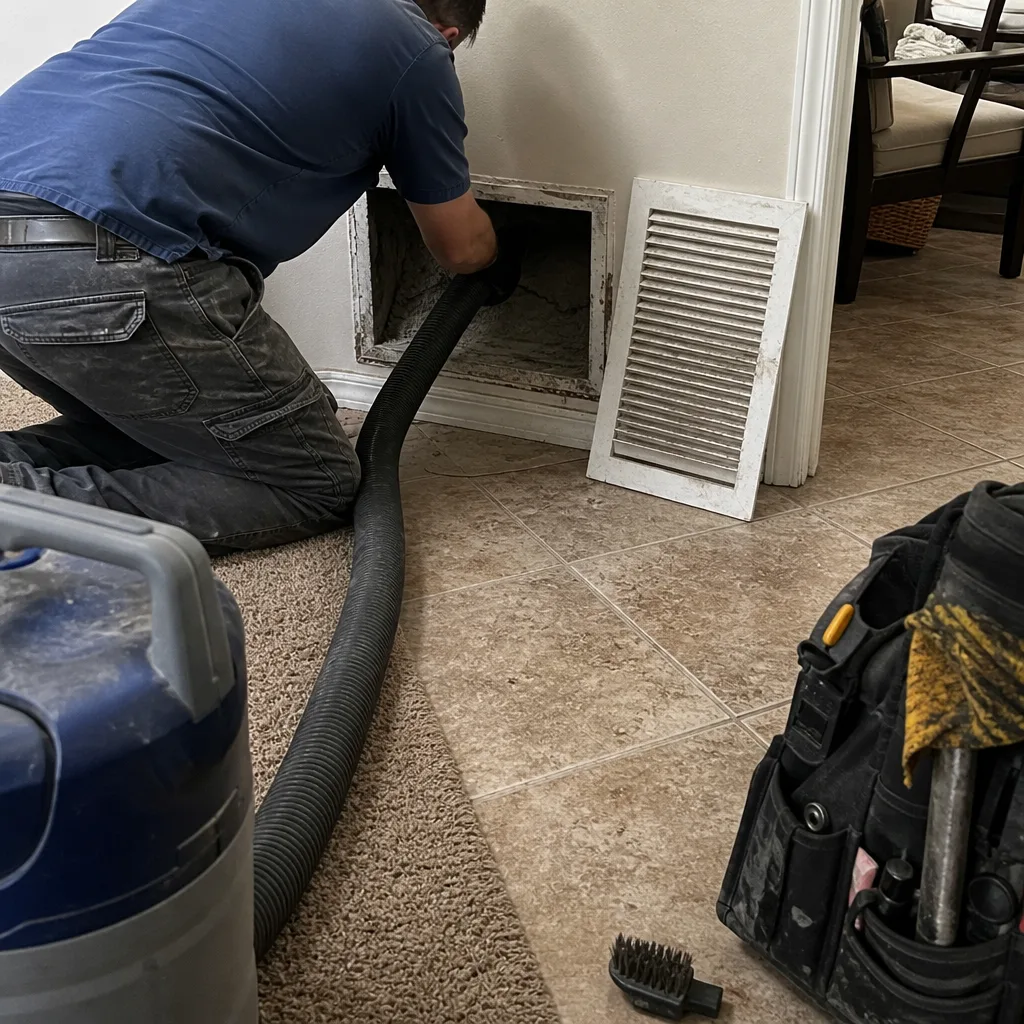 Before
 After
 Before
 After