
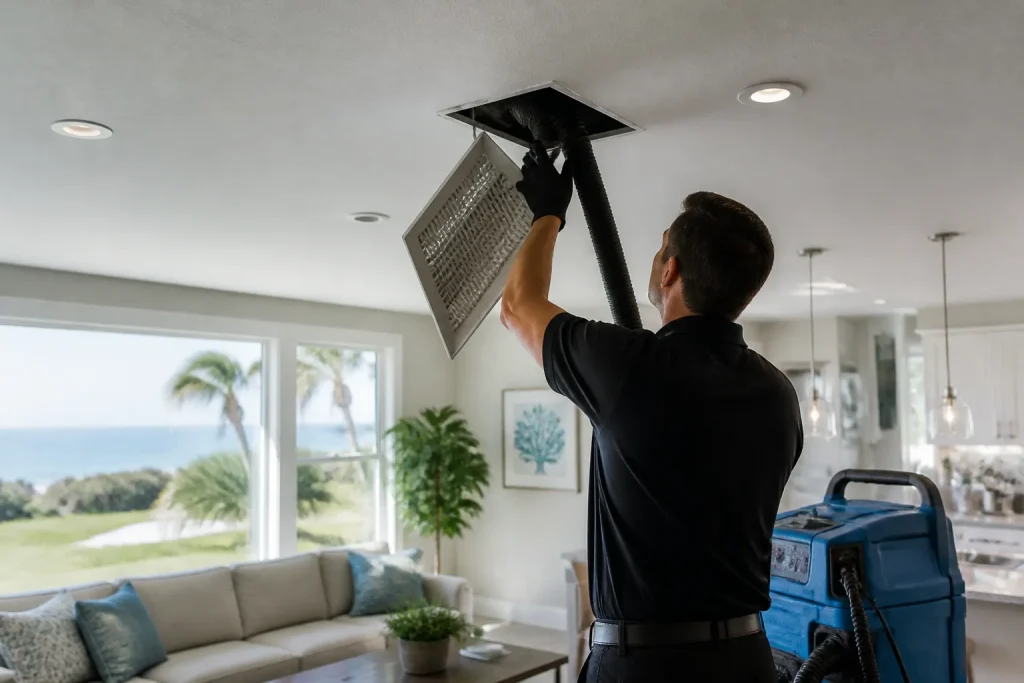
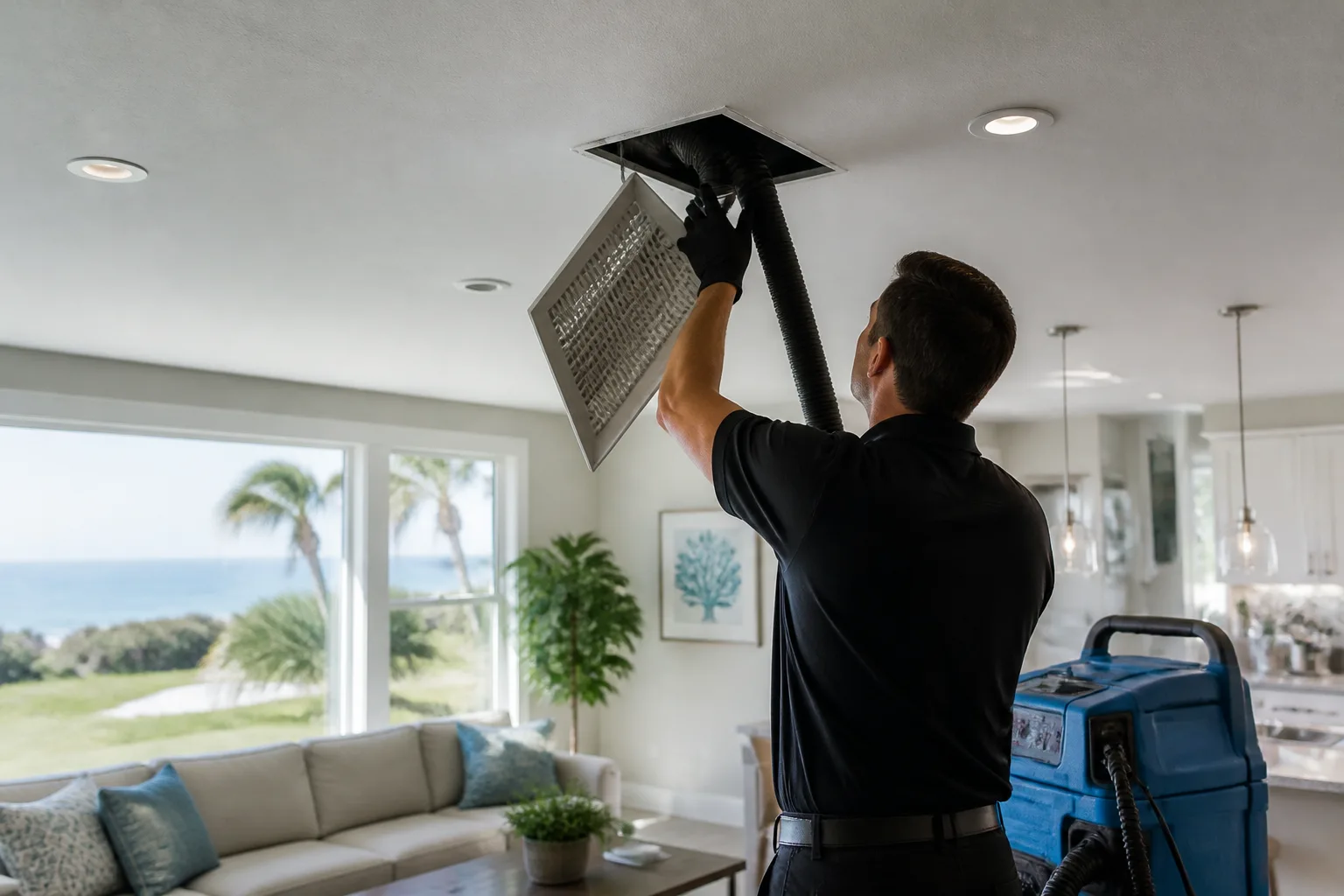
Emergency Air Duct Cleaning Near Me: What Encinitas Homeowners Should Do First
In a genuine duct emergency, the first call shouldn’t be to a cleaning company. The first 90 minutes determine whether you’re dealing with a contained cleaning job or a house-wide contamination event. Here’s the sequence: shut the HVAC down, document everything, contain the affected area, then call a specialist. If you’d rather skip the reading and get a pro on the phone right now, call (866) 596-9358 and we’ll walk you through it.
What Actually Counts as a Duct Emergency
Most calls we get labeled “emergency” are urgent but not true emergencies. A musty smell when the AC kicks on, visible dust at the registers, or a vent that’s been closed for three years are problems worth fixing soon. They don’t require a 2 a.m. response.
A genuine emergency in Encinitas falls into one of three buckets:
- Sewage or water intrusion into ductwork – a backed-up floor drain near a return, a supply leak above a trunk line, or a bathroom overflow that reached a floor register. This is Category 3 water in confined spaces. It doesn’t dry out on its own and it doesn’t just smell bad. It grows things.
- Rodent or animal intrusion – a rat, mouse, or squirrel that died in a supply trunk or built a nest in a return plenum. Coastal Encinitas neighborhoods, especially older homes in Leucadia and Cardiff with raised foundations, see this more than people want to think about.
- Wildfire smoke saturation – heavy smoke pulled through the HVAC during a Santa Ana wind event leaves oily particulate on every interior duct surface. It’s not visible like a burned wall, but it keeps off-gassing for months.
What makes these different from a dirty duct is simple: in all three, harmful material is actively causing contamination. A dusty duct is just dirty. A sewage-soaked return is a live biological issue. The distinction changes who you call, what equipment they need to bring, and whether you should be in the house while it’s being handled.
Step One: Shut the System Down – But Do It Right
The single biggest mistake Encinitas homeowners make during a duct emergency is leaving the HVAC fan running. Sometimes it’s because they’re trying to “air things out.” Sometimes they just don’t think about it. Either way, it’s the wrong move.
Here’s why: your air handler moves 1,200 to 2,000 cubic feet per minute of air through the duct system. If a rodent died in a supply trunk or sewage backed into a return, that fan is now spraying aerosolized particles into every room connected to a register. What was a 30-square-foot problem in one duct run becomes a whole-house contamination event in under an hour.
The correct shutdown sequence:
- Turn the thermostat to “OFF.” Not heat, not cool, not fan on. Off.
- Switch the air handler breaker off at the electrical panel if you know which one it is. If you don’t know, this is the time to find it. Label it for the future.
- Close the register grilles in the room where the problem originated. Don’t tape them yet – just close the louvers to slow air movement.
- Leave the house, if the odor is powerful, to reduce your exposure while you plan next steps. This is especially important with sewage-related contamination, where the air itself can carry pathogens.
One exception: if the emergency is a wildfire smoke event, the system should still be off, but not because it’s spreading visible smoke. It’s because the HVAC is now coated internally with smoke residue, and running it bakes that oily particulate into the duct liner and coil fins. Wait until a professional inspects it.
Step Two: Document Everything Before You Touch Anything
If you’re going to file an insurance claim for sewage, water, or smoke damage, the difference between full coverage and a denied claim often comes down to what you captured in the first hour.
We’ve walked through a smoke-remediation job in Encinitas Ranch where the homeowner’s photos of the supply registers and his handwritten timeline made the adjuster’s job straightforward. The claim was approved in three days. We’ve also seen claims drag on for months because the homeowner started cleaning before documenting and couldn’t prove what happened.
Take these steps before any cleanup begins:
- Photograph the source. The overflowed drain, the smoke-stained walls, the animal droppings near the foundation vent. Wide shots and close-ups. Your phone timestamp is automatic.
- Photograph the registers and grilles in the affected room and, if you can, the inside of the duct through the register opening. Use the phone flash.
- Write down the timeline. When you first noticed the smell, what the thermostat was set to, when you shut the system off, who you called, and at what time. This seems like overkill, and it’s exactly what an adjuster asks for.
- Keep receipts but don’t start cleaning. Any materials you buy should be logged. But do not start washing duct surfaces or pouring anything into the registers. That risks creating evidence the insurance company’s remediation vendor will say altered the condition.
If the emergency is a sewage event, take the documentation steps and leave. Do not open the ductwork to “see how bad it is.” That’s for the professional with proper containment equipment.
Step Three: The Difference Between a Real Emergency Clean and a Same-Day Visit
Every air duct company has a “call us anytime” line. Very few of them have the setup to actually handle a contamination event. This is not a knock on other contractors – residential duct cleaning schedules run Monday through Friday. Emergency capability is a different operational model.
But you can’t tell from a phone call who’s real. You tell from the questions they ask and the equipment they cite.
A legitimate emergency-capable duct cleaner needs these components on the truck or ready at the shop when a genuine contamination call comes in:
- A true HEPA-filtered negative air machine. Not a shop vac, not a fancy canister vacuum with a HEPA filter attached. A ducted air scrubber, such as those we run from Abatement Technologies, is what creates the negative pressure needed to keep contaminants from leaving the ductwork while it’s being agitated. This is standard equipment in commercial remediation, and it’s what’s needed for any sewage or rodent event.
- Rotary brush system with vacuum collection. A Nikro or similar rotating brush system can physically dislodge particles that are adhered to the duct surface. This is what removes the aerosolized material from the duct wall, where a vacuum alone can’t get it.
- Duct access capability. A real emergency clean includes cutting access holes in the ductwork when needed, cleaning through them, and sealing them properly afterward. If a company doesn’t do duct repair, they can’t do this.
- Replacement duct sections on hand. If a section of flex duct or a segment of trunk line is saturated with sewage or soaked in animal waste, it’s getting replaced, not cleaned. That requires doing actual repairs on-site.
This is also the point in the process where the distinction between cleaning-only companies and a duct specialist like ours matters. We don’t have to finish a cleaning job and refer you to someone else because the ductwork itself is compromised. Air duct repair in Encinitas is part of the same visit. One team, one scope, one invoice, one day.
What a Post-Emergency Cleaning Actually Covers
A post-emergency duct cleaning in a coastal town like Encinitas – where ductwork often runs through unconditioned crawl spaces and humidity averages 70 percent – is rarely just a duct brushing. If a company sells it as just duct cleaning, you’re not getting what the event requires.
A proper scope for a sewage, rodent, or smoke event includes the following:
- Complete duct-system cleaning – all supply trunks, return plenums, branch lines, and register boots. Every linear foot, down to the point where the duct meets the wall.
- Evaporator coil cleaning. For smoke events especially, the coil is a filter that caught the worst of the airborne particulate. If it’s not cleaned, the smoke smell returns the first time the AC runs in the summer.
- Filter housing replacement. You don’t clean a smoke-soaked filter housing. You replace it. Along with installing a fresh media filter – often a Honeywell or Aprilaire media cabinet if the old one was a one-inch disposable.
- Blower wheel inspection and cleaning. The fan that moves all the air is inside the air handler. If the system ran during the event, the blower is coated too.
- Duct replacement where indicated. Saturated porous duct liner can’t be cleaned. Damaged flex duct from a rodent infestation can’t be cleaned. It comes out.
This is also the moment to ask whether the system needs ongoing air-quality support rather than a one-time clean. After a smoke event in a canyon neighborhood like Olivenhain, we’ll often recommend a media air cleaner rated for smoke particulates – not as an upsell, but because a standard one-inch fiberglass filter won’t do anything against the kind of sub-micron particles that linger after a wildfire event.
When You Can Wait Until Tomorrow
We don’t want to be the company that tells everyone in Encinitas they need to spend emergency money on a non-emergency. So here’s the honest version.
These situations can wait for a standard scheduled visit:
- Dust blowing from the registers when the system starts
- A general mustiness when the heat runs for the first time in December
- Dryer taking longer than usual to dry clothes (though don’t wait months – dryer vent cleaning in Encinitas is one of the most overlooked fire-prevention steps)
- Visible dust accumulation around a register, especially in beach-close homes near Moonlight Beach where salty air keeps homes sealed up tight
- Allergies that ease when you’re out of the house
These are all legitimate reasons to book a cleaning. They just don’t require an emergency response. You’ll get better pricing, better scheduling, and better results booking them as a regular air duct cleaning in Encinitas.
The emergency label applies when contamination is actively being spread or creating a health and safety issue. Sewage, dead animals, wildfire smoke. If it’s one of those three, follow the shutdown and documentation protocol above and call us. If it’s something else, call us too – but on a normal schedule.
How to Choose Who to Call When It’s Real
If you’re in the middle of a genuine emergency, you don’t have time to interview three companies. You need to make one call and trust that the person on the other end knows what a real emergency requires.
Here’s what to listen for in that first phone call:
- They ask what happened before they give a price. A real specialist asks about the sewage backup or the smell or the smoke event. A booking agent just wants to get you on the schedule.
- They tell you what to do before they arrive. At minimum, that should include “shut the system off.” If the person on the phone doesn’t say that within the first two minutes, you’re talking to a scheduler, not a technician.
- They can name the equipment they’re bringing. Rotary brush system. HEPA negative air. Duct access tools. Replacement duct material. If they can’t, they’re coming with a vacuum and a brush from the hardware store.
- They don’t promise a one-vent price. A real contamination event gets scoped on-site. Any per-vent price is a teaser number designed to get a crew in your driveway. That’s how bait-and-switch duct cleaning works, and we’ve had too many Encinitas homeowners show us invoices from other companies that started at $99 and ended over a thousand.
We offer one flat price for the entire duct system, agreed to before any work starts. You see the price, you approve the price, and that’s the price. No per-vent pricing, no add-on fees for the equipment that was always going to be part of the job anyway.
And here’s a specific point that matters in a town like Encinitas, where a third of the housing stock predates 1980: older duct systems are more likely to be physically compromised. We pulled a disconnected return duct out of a crawl space in Leucadia last month that had been pulling unfiltered crawl-space air into the living room – the homeowner had called about a “musty smell” and what they actually had was a four-inch gap in the return trunk. That’s why every cleaning we do includes a physical inspection of the duct runs, not just the interior surfaces. We are looking at the system as a system, not just a surface to be wiped.
The Bottom Line
Emergency air duct cleaning in Encinitas is rarely just cleaning. It’s a response to a specific contamination event, and the actions you take before the truck arrives matter as much as what the crew does once they’re there. Shut the system down. Document everything. Don’t touch anything. Then call a specialist who can bring remediation-grade equipment and repair the ductwork if it’s compromised.
We’ve been doing this in Encinitas since 2017, and our entire shop is built around one trade: ducts. Duct cleaning in Encinitas is what we do, not a sideline. That means the same team that cleans your ducts can repair a damaged trunk line, replace a saturated flex run, and install the Aprilaire or Honeywell filtration that keeps the air clean after the job is done – no referrals, no separate appointments, no runaround.
If you need help with an emergency event or just want your ducts inspected for the first time, call (866) 596-9358. Estimates are free, and we’ll tell you honestly if you need emergency service or if a scheduled visit makes more sense.
Frequently Asked Questions
Yes, but only if the cleaning scope includes the evaporator coil, blower wheel, and filter housing, not just the duct interiors. Wildfire smoke particles are oily and sub-micron, so they coat every surface air passes over. A rotary brush cleaning with a proper HEPA-filtered negative air machine from Abatement Technologies can remove the particulate from duct surfaces, but if the coil and blower are skipped, the smoke smell returns the first time the AC cycles. For a full assessment of your system after a smoke event, call (866) 596-9358.
Response time depends on the scope and the nature of the event. Emergency calls get prioritized within our existing schedule, but this is a specialized service requiring specific equipment – a Nikro rotary brush system and HEPA negative air – not a tech with a vacuum. We’ll take your call, ask what happened, and either dispatch quickly for a true contamination event or schedule the soonest appropriate slot for urgent-but-not-emergency work. Call (866) 596-9358 and we’ll tell you straight which one yours is.
No. Running the fan after a sewage backup or rodent intrusion aerosolizes contaminants and spreads them through the entire duct system – and the whole house. Shut the system off at the thermostat and the breaker, close the registers in the affected room, and leave the system off until a professional has assessed the damage and either cleaned or replaced the affected sections. No exceptions.
Coverage depends on the cause. Sewage backup, water intrusion from a covered peril, and wildfire smoke damage are often covered, while rodent damage is frequently excluded. The single biggest factor in claim success is documentation: photos of the source, photos of the registers, a written timeline, and no attempt at self-cleaning before the adjuster sees it. Take the documentation steps before calling anyone, including your insurer.
Written by the team at Duct Cleaning Encinitas, serving Encinitas since 2017.
Need Air Duct Cleaning Help?
Call Duct Cleaning Encinitas - licensed & insured, with free written estimates in Encinitas.
(866) 596-9358